
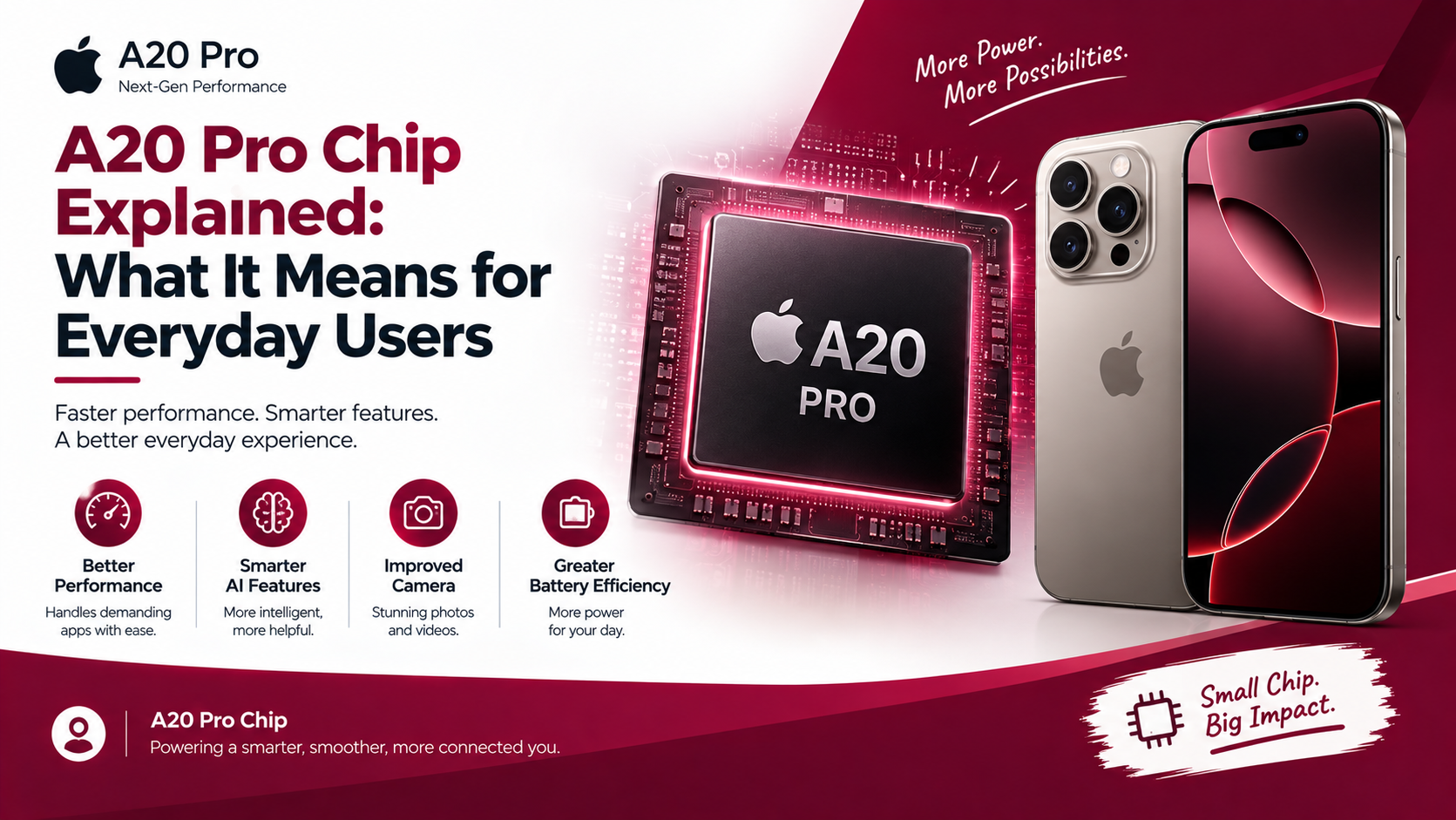
Apple just announced the A20 Pro chip, and the spec sheet reads like a foreign language: 2nm process, dual 16-core Neural Engine, seven-core GPU with ray tracing. If your eyes glazed over reading that, you're not alone. Here's the thing though, none of these numbers matter on their own. What matters is how they change the way your phone actually feels when you use it every day. Let's translate the marketing language into real answers.
What Exactly Is the A20 Pro Chip?
The A20 Pro is Apple's newest flagship processor, powering the iPhone 18 Pro, iPhone 18 Pro Max, and Apple's first foldable iPhone. It's not just a minor speed bump over last year's chip, Apple rebuilt nearly every major component inside it, from the CPU architecture to the graphics engine to the AI processing hardware.
A 2nm Process: Why That Number Actually Matters
Every chip is built using transistors, and the "2nm" label refers to how small and densely packed those transistors are. Apple's A20 Pro is widely believed to use TSMC's N2 process, making it the first smartphone chip on the market built this way. Smaller transistors generally mean better efficiency, since the chip can do more work while generating less heat and draining less battery. In plain terms, the A20 Pro packs more computing power into the same tiny space without punishing your battery life for it.
A20 Pro CPU: Two "Super" Cores Changing the Game
Apple kept the same six-core CPU layout it's used for years, but the details underneath changed significantly. Two of those six cores are now what Apple calls "Super" cores, described as desktop-class performance cores, paired with four efficiency cores that handle lighter everyday tasks.
For everyday use, this split matters more than it sounds. Simple tasks like scrolling social media or checking email lean on the efficient cores, sipping minimal battery. However, when you open a demanding app, edit a video, or jump into an intense mobile game, the Super cores kick in and deliver noticeably snappier performance. Apple claims up to 40% more sustained performance compared to the A19 Pro, meaning the A20 Pro chip doesn't just perform well in short bursts, it holds that performance steady during longer, heavier tasks.
A20 Pro GPU: 40% Faster Graphics and Real Ray Tracing
The graphics side gets an equally significant upgrade. The A20 Pro moves to a seven-core GPU, up from six cores previously, and adds hardware-accelerated ray tracing along with new Neural Accelerators built directly into the graphics engine. Apple states this delivers up to 40% better graphics performance than the previous generation.
If you're a casual user, this mostly shows up as smoother animations, faster app transitions, and less lag when switching between apps. If you play graphically intensive mobile games, though, this is where the A20 Pro chip genuinely shines, since ray tracing enables more realistic lighting and shadows that were previously reserved for gaming consoles and high-end PCs.
The Neural Engine: Where On-Device AI Gets Serious
Here's the upgrade that quietly matters most going forward. Apple doubled the Neural Engine in the A20 Pro chip, moving from a single 16-core design to a dual 16-core setup, totaling 32 Neural Engine cores. Combined with new Neural Accelerators inside the GPU, Apple claims this delivers twice the AI processing power of the previous generation.
What This Means for Apple Intelligence
Every Apple Intelligence feature, from writing tools to smarter Siri responses to on-device photo editing, relies on this Neural Engine to run without sending your data to the cloud. A more powerful Neural Engine means these features respond faster and handle more complex requests directly on your phone. Practically speaking, if you've felt like Apple Intelligence sometimes lags or struggles with certain tasks on older hardware, the A20 Pro chip is specifically built to fix that friction, not just add another feature layer on top of it.
Cooler Under Pressure: How the New Vapor Chamber Helps
Powerful chips generate heat, and heat is exactly what forces phones to slow down during long gaming sessions or heavy video exports, a process called thermal throttling. Apple redesigned the internal chip package for the A20 Pro, removing memory from the direct thermal path and significantly expanding the vapor chamber's surface area. This keeps the chip running cooler for longer, which directly supports Apple's sustained performance claims. In everyday terms, this means your phone is far less likely to slow down midway through a long gaming session or a lengthy video call, even after your phone starts feeling warm in your hand.
Real-World Benefits: What Everyday Users Will Actually Notice
Specs are one thing, but here's what actually changes in daily use.
Gaming and Video Editing
Games load faster, run smoother, and look noticeably better thanks to ray tracing support. Meanwhile, video editing apps export footage quicker, and effects that used to cause stuttering now render in real time.
Photography and Computational Imaging
Modern iPhone cameras rely heavily on computational processing, not just the physical lens. A stronger Neural Engine means faster processing for portrait mode, night mode, and other AI-driven photo features, often shaving real seconds off the time between pressing the shutter and seeing your final shot.
Battery Life
Better efficiency at the transistor level, combined with smarter task distribution across CPU cores, translates into meaningfully longer battery life. Apple has already tied its longest-ever iPhone battery claims directly to the A20 Pro chip's efficiency gains.
Longevity: Future-Proofing Your Purchase
Perhaps the most underrated benefit: a chip this far ahead of the curve tends to keep phones feeling fast for years longer. If you're the type who keeps a phone for four or five years, buying into this generation's hardware now means iOS updates and future app requirements are less likely to slow your device down prematurely.
A20 Pro vs A19 Pro: Is the Upgrade Worth It?
If you're currently using an iPhone with the A19 Pro chip, the honest answer depends on how you use your phone. Casual users who mostly browse, message, and stream video may not notice a dramatic day-to-day difference right away. However, anyone who games heavily, edits video on the go, or relies constantly on Apple Intelligence features will likely feel the difference immediately, particularly during longer, more demanding sessions where the A20 Pro chip's sustained performance and improved cooling really pull ahead.
Frequently Asked Questions
What makes the A20 Pro chip different from the A19 Pro?
The A20 Pro moves to a more advanced 2nm manufacturing process, adds two desktop-class "Super" CPU cores, upgrades to a seven-core GPU with ray tracing, and doubles the Neural Engine to 32 total cores, resulting in significantly better sustained performance and AI processing.
Does the A20 Pro chip actually improve battery life?
Yes. The combination of a more efficient manufacturing process and smarter workload distribution across CPU cores allows the chip to do more work while consuming less power, which Apple ties directly to its improved battery life claims for devices using this chip.
Will the A20 Pro chip make my apps load faster?
Generally, yes, especially for demanding apps like games, video editors, and AI-powered tools. Lighter apps like messaging or browsing were already fast on previous chips, so the difference there will feel more subtle.
Is the A20 Pro chip only useful for gamers?
Not at all. While gamers benefit noticeably from the GPU and ray tracing improvements, everyday users gain from faster Apple Intelligence responses, smoother multitasking, better camera processing, and improved battery efficiency, benefits that apply regardless of how intensively you use your phone.
Is a 2nm chip actually better than previous chips in practice?
In most cases, yes, since smaller transistors generally allow for both higher performance and better efficiency simultaneously. That said, real-world performance also depends on software optimization, so independent testing after devices ship will confirm how these theoretical gains translate into daily use.
The A20 Pro chip isn't just a bigger number on a spec sheet, it's a genuine architectural shift across the CPU, GPU, and Neural Engine that touches nearly everything your phone does. Whether you notice it through smoother games, faster AI features, or simply a battery that lasts longer than you expect, this generation of silicon is built to make your daily experience feel noticeably better, not just technically impressive on paper.
Ready to upgrade? Browse the latest iPhone 18 Pro Max deals and trade-in offers at Milaaj for the best price in the UAE.
Other Services / Shopping Categories:
Looking for new gadgets? Explore Milaaj’s latest smartphone collection.
Need a laptop upgrade? Check out Milaaj’s laptops and MacBooks.
Selling your used devices? Get instant cash when selling your old iPhone or electronics with Milaaj.
Want tech accessories? Shop genuine chargers, cables, and power banks on Milaaj.