
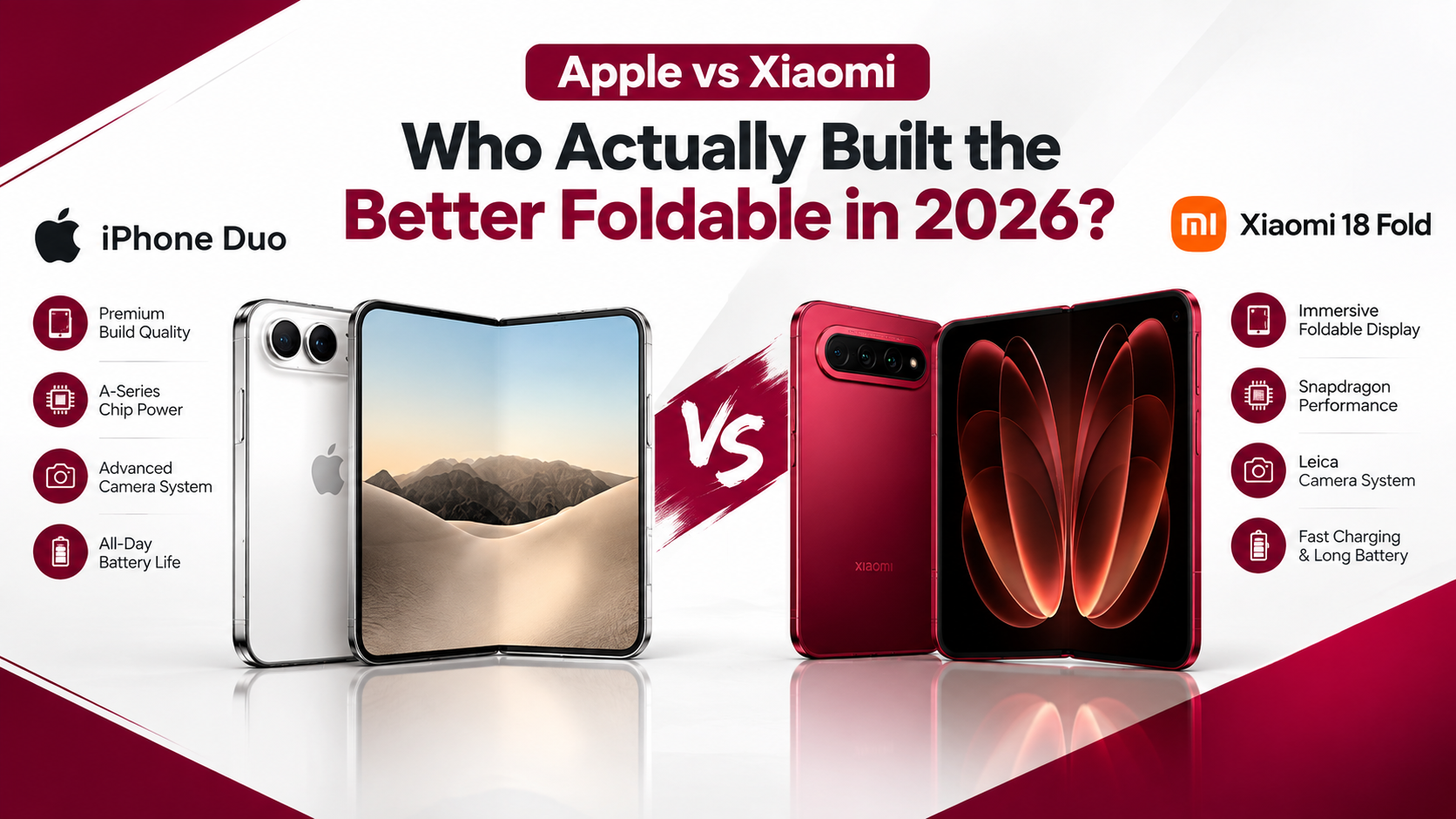
For years, Apple sat out the foldable race while Samsung, Google, and Xiaomi refined the format. Then, within 48 hours of each other in September 2026, Apple and Xiaomi both dropped their most ambitious foldables yet. Naturally, everyone wants the same answer: in the Apple vs Xiaomi foldable debate, who actually won? We went category by category to find out, and the result isn't as one-sided as either fanbase probably expects.
The Foldable Race Just Changed Overnight
Xiaomi launched the 18 Fold in China on September 7, 2026. Apple followed two days later with the iPhone Duo, unveiled by new CEO John Ternus as the closing moment of the "Surprise and Shine" keynote. Whether that timing was coincidence or calculated positioning, it turned what could've been two separate product stories into a direct Apple vs Xiaomi foldable showdown, and tech media hasn't stopped comparing them since.
Engineering Philosophy: Two Completely Different Bets
Before comparing specs line by line, it helps to understand what each company actually prioritized, because they clearly made very different bets.
Apple's Bet: Restraint and Polish
Apple's approach favors fewer features, executed with obsessive attention to fit and finish. The iPhone Duo skips a dedicated telephoto lens, launches in just two colors, and leans entirely on Touch ID instead of Face ID. Every decision reads like a company choosing polish over a longer spec sheet.
Xiaomi's Bet: Speed and Specs
Xiaomi, by contrast, packed the 18 Fold with a custom in-house chip, a Leica-tuned triple camera system, and considerably faster charging. This is a company betting that raw capability and hardware ambition will win over buyers faster than restraint will, particularly among power users who read spec sheets closely before buying anything.
Round 1: Design and Durability
The iPhone Duo uses an aerospace-grade titanium frame with ceramic fiber reinforcement, Ceramic Shield glass, and an IP68 rating, all wrapped in just two understated colorways. The Xiaomi 18 Fold counters with its distinctive "dragon bone" hinge and a bold red finish that immediately stands out, while matching Apple's IP68 durability rating. On pure engineering restraint, Apple edges ahead here, but Xiaomi wins on visual personality. Call this round a tie, decided entirely by personal taste.
Round 2: Display Technology
Both companies landed on nearly identical display sizes, a sign of how quickly the entire foldable category is converging around a single ideal form factor. The iPhone Duo offers a 5.4-inch outer and 7.6-inch inner display, while the Xiaomi 18 Fold comes in at 5.38 inches and 7.58 inches respectively. Apple's nano-texture finish specifically targets crease visibility, historically the biggest complaint against every foldable phone ever made. Xiaomi has made similar claims about its own crease reduction. Until independent hands-on reviews settle this definitively, we're calling this round essentially even.
Round 3: Performance and Chipsets
This is where the Apple vs Xiaomi foldable comparison gets genuinely interesting. Apple's A20 Pro chip, built on a 2-nanometer process, powers the iPhone Duo with the same silicon found in the iPhone 18 Pro lineup. Xiaomi used its foldable flagship to debut something bolder: the XRing O3, a 3-nanometer deca-core chip designed entirely in-house rather than licensed from Qualcomm. That's a genuinely significant move, signaling real ambition to control its own silicon roadmap. Apple still likely holds the sustained performance edge based on its track record, but Xiaomi deserves real credit for the attempt alone. Point to Apple, but only narrowly.
Round 4: Camera Systems
Apple equipped the iPhone Duo with a 48MP Fusion main and 48MP Fusion ultrawide, plus an under-display Center Stage front camera that eliminates any notch entirely. Xiaomi leaned on its long-running Leica partnership, fitting the 18 Fold with a triple rear system that reportedly includes a dedicated telephoto lens with real optical zoom, something the Duo skips entirely. For anyone who actually zooms in on photos regularly, Xiaomi's more versatile camera hardware gives it a genuine edge in this round.
Round 5: Battery and Charging
Apple claims up to 45 hours of video playback from the iPhone Duo's dual-cell battery design. Xiaomi's 18 Fold packs a 6,000mAh cell supporting 67W wired and 50W wireless charging, numbers that dramatically outpace anything Apple has ever shipped. Even if Apple's battery life claims hold up in independent testing, charging speed is a clear, decisive win for Xiaomi.
Round 6: Ecosystem and Software
The iPhone Duo runs a foldable-adapted version of iOS built around Apple's Liquid Glass design language, with Split View multitasking and upcoming Apple Pencil support. The Xiaomi 18 Fold runs HyperOS 4 on Android 17, giving it access to the significantly larger Android app catalog and Xiaomi's own multitasking refinements built over several foldable generations. This round genuinely depends on which ecosystem you're already invested in, so we're calling it a wash on pure merit, though Apple's ecosystem lock-in tends to matter more once you're already inside it.
Round 7: Price and Accessibility
Here's where the Apple vs Xiaomi foldable comparison stops being close. The iPhone Duo starts at $1,999 and ships globally starting October 23, 2026. The Xiaomi 18 Fold, despite launching first, remains exclusive to China with no confirmed international rollout. However impressive Xiaomi's hardware looks on paper, a phone most of the world can't actually buy loses this round decisively.
So, Who Actually Won?
Add it all up, and the Apple vs Xiaomi foldable battle ends closer to a draw on pure engineering than either company's marketing suggests. Xiaomi wins on camera versatility, charging speed, and sheer hardware ambition. Apple wins on build refinement, chip maturity, and, most importantly, actually being available to buy nearly everywhere in the world. For most people outside China, that last point alone settles it: the iPhone Duo is the foldable you can actually own. For buyers in China weighing raw specs against brand loyalty, the Xiaomi 18 Fold makes a genuinely compelling case for itself, and in a few categories, it simply does more.
Frequently Asked Questions
Which foldable performs better, iPhone Duo or Xiaomi 18 Fold?
Apple's A20 Pro chip likely holds a sustained performance advantage based on Apple's historical track record, though Xiaomi's new in-house XRing O3 chip is a genuinely ambitious first attempt worth watching in independent benchmarks.
Does the Xiaomi 18 Fold have a better camera than the iPhone Duo?
In terms of versatility, yes, since the Xiaomi 18 Fold includes a dedicated telephoto lens that the iPhone Duo's simpler dual-camera setup lacks. Overall image quality and video consistency will depend on real-world testing.
Can I buy the Xiaomi 18 Fold outside China?
Not officially, at least not yet. Xiaomi has only confirmed a China launch for the 18 Fold, meaning buyers elsewhere would need to import the device through third-party sellers rather than purchasing it locally.
Is the iPhone Duo worth its $1,999 starting price?
For buyers already inside Apple's ecosystem who want a foldable with global availability and Apple's typical build quality, yes, most reviewers consider it a reasonable price for a category-defining first-generation device.
Which foldable has better battery life, Apple or Xiaomi?
Apple claims up to 45 hours of video playback on the iPhone Duo, while Xiaomi's 18 Fold pairs a large 6,000mAh battery with much faster charging speeds. Battery longevity may favor Apple, but Xiaomi clearly wins on charging convenience.
The Apple vs Xiaomi foldable rivalry didn't need a marketing campaign to become the story of September 2026, it happened simply because two genuinely capable devices landed two days apart. Neither company built a flawless foldable, but both built one worth taking seriously, and that alone says a lot about how far this category has come.
Other Services / Shopping Categories:
Looking for new gadgets? Explore Milaaj’s latest smartphone collection.
Need a laptop upgrade? Check out Milaaj’s laptops and MacBooks.
Selling your used devices? Get instant cash when selling your old iPhone or electronics with Milaaj.
Want tech accessories? Shop genuine chargers, cables, and power banks on Milaaj.