
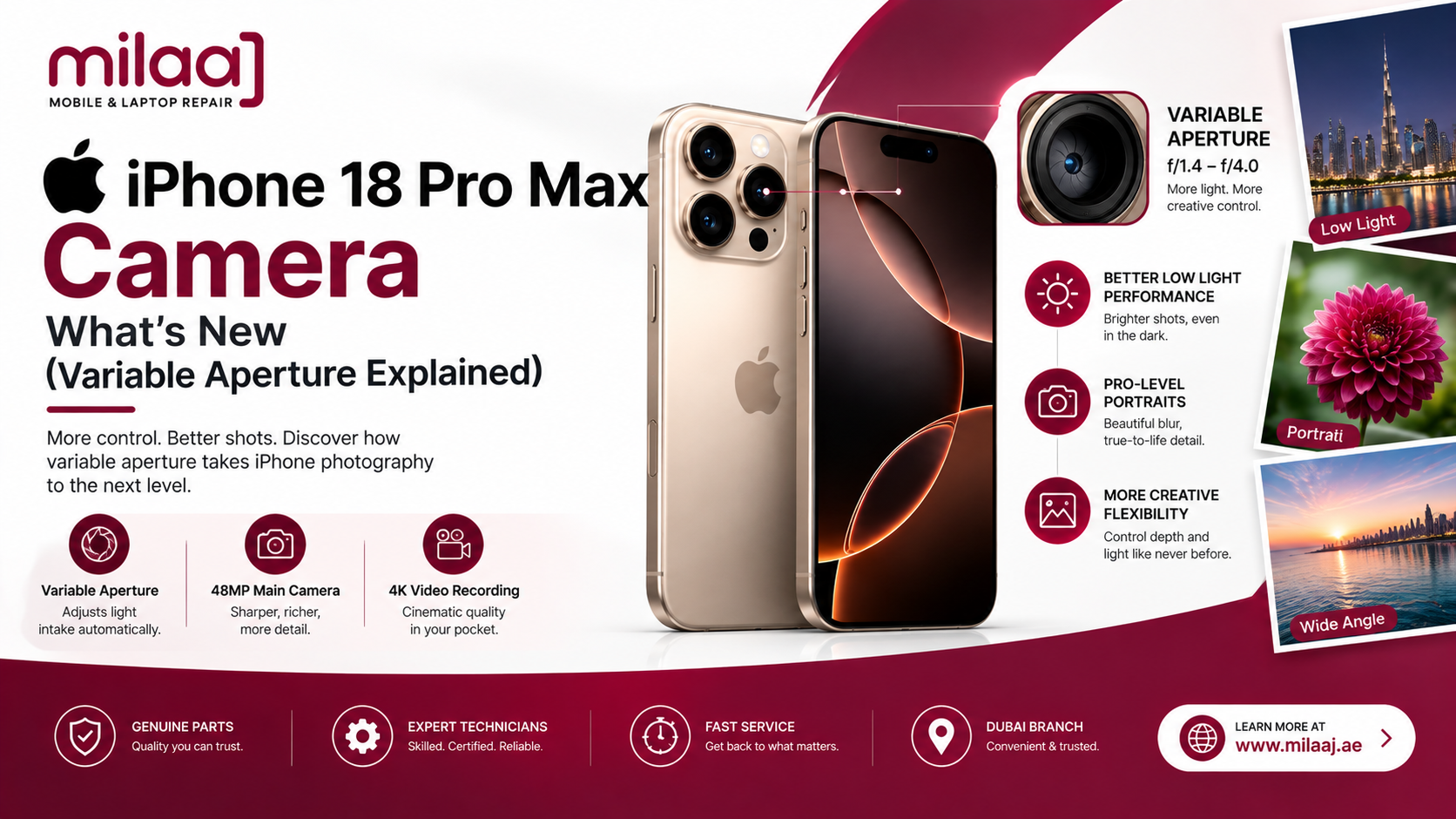
Apple’s official debut of the iPhone 18 Pro Max brings the most significant shift in mobile optical engineering since the introduction of sensor-shift stabilization. While mega-pixel counts and software processing algorithms usually dominate smartphone camera upgrades, hardware optical control takes center stage.
The flagship feature of the camera system is the 48MP Fusion Main camera equipped with a mechanical variable aperture. Moving beyond fixed-aperture lenses, Apple introduces six physical, laser-cut blades inside the primary lens assembly that dynamically adjust the size of the lens opening.
How does physical variable aperture work in mobile photography? What practical benefits does it deliver over fixed lenses, and how does it elevate image quality for casual shooters and professional creators?
The Physical Upgrade: What Is Variable Aperture?
In traditional photography, aperture refers to the physical diaphragm opening inside a camera lens that controls two critical variables:
- Light Intake: How much light reaches the image sensor.
- Depth of Field (DoF): How much of the foreground and background stays in sharp focus versus soft background blur (bokeh)
For years, smartphones used fixed apertures—typically around $f/1.78$ or $f/1.8$. While wide fixed lenses gather ample light in dark environments, they create an optical downside: extremely shallow natural depth of field. Close-up shots of documents, food, or multi-person group photos often suffered from blurry edges or out-of-focus background faces because the plane of focus was overly narrow.
The iPhone 18 Pro Max camera variable aperture solves this hardware limitation. Controlled by a micro-rotor mechanism, six precision blades transition between four primary hardware steps:$f/1.48$,$f/1.8$,$f/2.8$, and$f/4.0$.
How the Camera System Uses Variable Aperture Real-Time
Apple integrates mechanical aperture blades directly into its iOS computational pipeline and the new A20 Pro processor. The system operates seamlessly in automatic mode while giving enthusiasts full manual control.
[ Scene Analysis Engine ] │ ┌───────────────────────┴───────────────────────┐ ▼ ▼[ Low-Light / Single Subject ] [ Group Shot / Landscape ] • Blades open wide to ƒ/1.48 • Blades narrow to ƒ/4.0 • Maximizes light intake • Expands plane of focus • Soft background bokeh • Keeps every face sharp
1. Superior Low-Light Capture at $f/1.48$
Opening the lens mechanism to its widest $f/1.48$ setting allows the main sensor to capture substantially more physical light compared to previous generations. Night mode shots process faster, capture higher color accuracy, and reduce digital noise without relying on aggressive AI smoothing.
2. Deep Focus for Group Shots at $f/4.0$
When taking group photos, fixed wide apertures often leave people in the front row sharp while blurring those standing in the row behind. By automatically narrowing the physical iris to$f/4.0$, the camera extends its depth of field, keeping everyone in the frame crisp from edge to edge.
3. Edge-to-Edge Document Clarity
Macro photography and document scanning benefit immediately from stopping down to $f/2.8$ or $f/4.0$. Edge distortion and corner softness disappear, producing clean scans without switching to lower-resolution ultrawide lenses.
Pro Controls: Manual Camera Operation in iOS
Apple expands native camera software to unlock mechanical aperture control for professional photographers.
Photographers can manually dial in aperture values inside the native Camera app, choosing exact depth of field rendering for portraits, architecture, or street photography. Furthermore, Apple released a developer API that allows third-party creative suites like Halide and Filmic Pro to adjust mechanical lens positioning seamlessly across the aperture spectrum.
Complete Camera Matrix: iPhone 18 Pro Max Specifications
Beyond the primary variable aperture system, the entire camera platform gains meaningful upgrades:
Camera Lens | Hardware Specifications | Key Performance Features |
Primary Fusion | 48MP, Variable $f/1.48$ to $f/4.0$, OIS | Laser-cut 6-blade iris, zero shutter lag, 24mm/28mm/35mm focal steps |
Ultrawide | 48MP, $f/2.2$, 120° Field of View | Doubles as high-res Macro lens, quad-pixel autofocus |
Periscope Telephoto | 48MP, 5x Optical Zoom ($120\text{mm}$ equivalent) | Upgraded wider $f/2.6$ aperture, 3D sensor-shift stabilization |
Front Camera | 18MP Center Stage ($f/1.9$) | Dedicated autofocus, improved low-light portrait processing |
Video Engine | Up to 4K 120fps ProRes & Dolby Vision | Real-time cinematic depth tracking, Log 2 color space |
Pros and Cons
Pros
- Genuine optical depth-of-field control using physical aperture blades.
- $f/1.48$ maximum opening dramatically improves low-light photo and video capture.
- Narrower $f/4.0$ stop eliminates edge blur in close-ups and multi-subject group shots.
- Built-in Pro Controls introduce focus peaking, exposure histograms, and shutter speed locks.
- Reduces reliance on artificial portrait mode edge-detection algorithms.
Cons
- Moving mechanical components inside the camera module slightly increase mechanical complexity.
- Selecting manual aperture settings requires a small learning curve for non-photographers.
Final Verdict: Is the Variable Aperture Upgrade Worth It?
The iPhone 18 Pro Max camera variable aperture system marks a massive leap forward for mobile optics. Instead of relying exclusively on software algorithms to simulate background blur or balance light, Apple introduces real mechanical control that adapts flexibly to any environment.
Whether capturing low-light night scenes, sweeping landscape shots, or crisp group portraits, the mechanical lens iris gives creators unprecedented creative control directly on a smartphone.
Frequently Asked Questions (FAQs)
What is the advantage of a variable aperture camera on the iPhone 18 Pro Max?
Variable aperture allows the camera lens to physically widen or narrow its opening. Widening the lens ($f/1.48$) lets in maximum light for night shots, while narrowing the lens ($f/4.0$) expands focus depth to keep background details and group photos sharp.
Can I manually control the aperture on the iPhone 18 Pro Max?
Yes, iOS includes manual Pro Controls in the native Camera app that let users manually select physical aperture stops ($f/1.48$,$f/1.8$,$f/2.8$, or$f/4.0$).
Does variable aperture replace digital Portrait Mode?
While digital Portrait Mode remains available for exaggerated blur and lighting effects, the physical variable aperture delivers authentic, optical background bokeh without edge-detection artifacts.
How does variable aperture improve video recording?
Video creators can narrow the physical aperture ($f/4.0$) in bright sunlight to maintain cinematic shutter speeds ($1/50\text{s}$) without instantly overexposing the frame.
Other Services / Shopping Categories:
Looking for new gadgets? Explore Milaaj’s latest smartphone collection.
Need a laptop upgrade? Check out Milaaj’s laptops and MacBooks.
Selling your used devices? Get instant cash when selling your old iPhone or electronics with Milaaj.
Want tech accessories? Shop genuine chargers, cables, and power banks on Milaaj.